
Digital Marketing for Beginners
If you are reading this, you probably want to enter the world of digital marketing. Maybe you want a career change, maybe you want to grow your own side hustle, or perhaps you are just curious about how modern brands get customers today. Whatever your reason, here is the honest truth right from the start: digital marketing is no longer just about running ads or writing basic blog posts
In 2026, digital marketing is all about real human connection, reading data, and learning to work with Artificial Intelligence (AI) instead of trying to fight it. The online world moves very fast, but the basic psychology of why people buy things remains the exact same. If you can master the core concepts and stay adaptable, you will build a highly profitable, future-proof skillset.
This guide is designed completely for beginners. We will skip the confusing corporate jargon and give you a practical, step-by-step roadmap to launch your digital marketing journey this year.
Quick Navigation: What We Will Cover
Before we dive deep, here is a quick look at the exact roadmap we will follow in this guide. You can use this checklist to track your progress as you learn:

- Section 1: The New Landscape of 2026 – What actually changed this year?
- Section 2: The Core Pillars – The timeless foundations you must master.
- Section 3: Essential Tools – The tech stack you need (and most are free).
- Section 4: Your Step-by-Step Launch Blueprint – Going from zero to your first campaign.
- Section 5: Specializing vs. Being a Generalist – How to get hired or land clients.
1. What Digital Marketing Looks Like in 2026
To understand how to start, you first need to look at the environment you are entering. Digital marketing evolves every year, but recent shifts have permanently changed how consumers interact with businesses online.
The Rise of AI-Assisted Marketing
A few years ago, people worried that AI would replace human marketers completely. Today, we know better. AI is not taking our jobs. Instead, marketers who use AI are replacing the marketers who do not. As a beginner, you do not need to know how to code an AI algorithm. Instead, you just need to know how to write great prompts, edit AI-generated drafts to give them a human soul, and use smart tools to analyse customer data quickly.
Zero-Click Searches and Answer Engines
Traditional SEO (Search Engine Optimization) used to be simple: write a blog post, rank on Google, and get clicks. Now, users often get their answers directly from AI summary boxes on Google Search or conversational platforms like ChatGPT without clicking any links. This means modern marketing focuses heavily on building brand authority. You want your brand mentioned where people are having digital conversations.
The Demand for Absolute Authenticity
Because the internet is flooded with generic, automated AI content, human audiences have developed a strong filter for robotic messaging. People crave raw, authentic, behind-the-scenes content. TikTok, YouTube Shorts, and community spaces like Reddit or Discord are where buying decisions are heavily made today.
2. The 5 Pillars of Digital Marketing You Need to Know
Do not try to learn everything at once. Focus your energy on understanding these five foundational pillars. They form the bedrock of every successful marketing strategy.
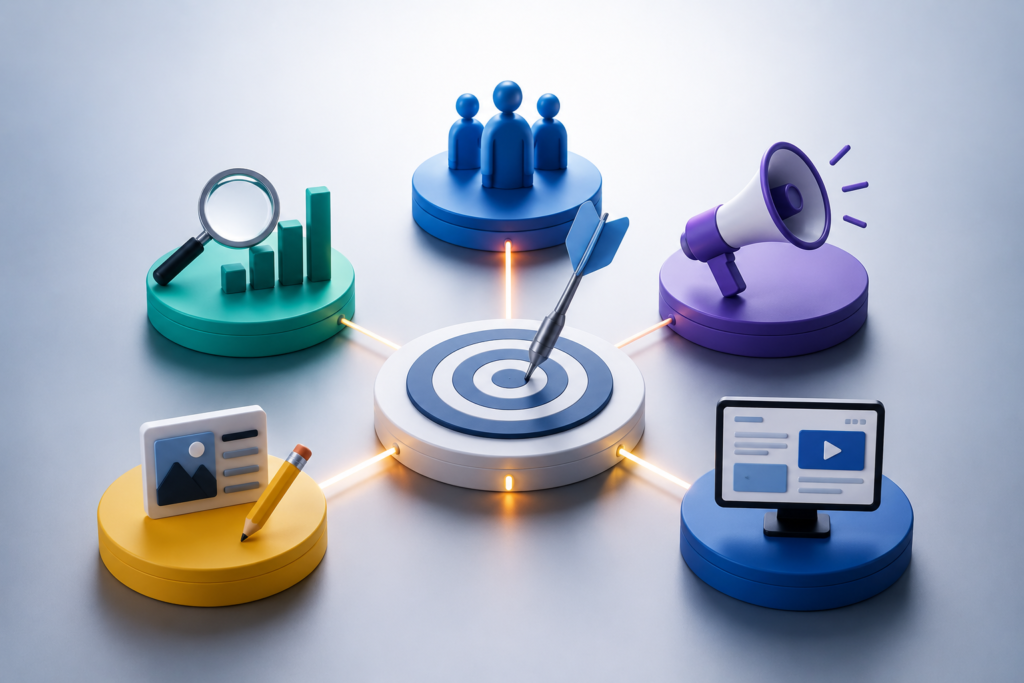
- 1: Content Marketing (Value & Education): Attracting audiences by solving their minor problems for free and earning their trust over time through educational blogs, video tutorials, or informative newsletters.
- 2: Social Media Marketing (Community): Engaging in two-way conversations and building a loyal following through short-form video (reels, shorts) and active community networking.
- 3: Search Engine Optimization (Intent & Discovery): Optimizing your website structure, speed, and keywords so your business pops up at the exact moment someone types a query into Google or asks an AI model.
- 4: Email & Retention Marketing (Retention & Trust): Owning a private list of subscribers that lets you speak directly to someone’s private inbox without worrying about social media algorithm changes.
- 5: Paid Advertising / Performance Marketing (Scalable Growth): Accelerating your growth trajectory by paying platforms like Meta, Google, or TikTok to show your message to a hyper-specific target audience.
3. The Digital Marketer’s Toolkit
You cannot build a house without tools, and you cannot run a digital marketing campaign without software. Luckily, the entry barrier is lower than ever. You do not need thousands of dollars to get started.
Tip: To maximise your marketing success, we highly recommend starting with the industry-standard software listed below.
- Content & Visuals (Canva, CapCut): Creating high-quality graphics and quick video edits without a degree. The learning curve is very easy.
- SEO & Keywords (Google Keyword Planner, AnswerThePublic): Figuring out exactly what questions your target audience is typing. Learning curve is moderate.
- Analytics & Data (Google Analytics 4): Tracking how many people visit your website and where they come from. The learning curve is steep.
- Email Marketing (MailerLite, ConvertKit): Building forms, gathering customer emails, and blasting newsletters. The learning curve is easy to moderate.
- AI Workflows (ChatGPT, Claude, Perplexity): Outlining strategies, brainstorming ad hooks, and cleaning raw data. Learning curve is easy.
4. Your Step-by-Step Blueprint to Start from Scratch
Knowing the concepts is great, but execution is everything. Follow this tactical 6-step blueprint to build your first real digital marketing setup.
Step 1: Choose One Specific Niche
Do not try to market to “everyone.” If you market to everyone, you appeal to no one. Pick a niche you already know well or are incredibly passionate about.
- Bad Niche: Fitness (Way too broad).
- Good Niche: Sustainable fitness gear for busy remote workers (Specific, clear target audience).
- Why it works: It is infinitely easier to create hyper-targeted copy and find a small group of highly dedicated buyers than it is to compete with massive multinational corporations.
Step 2: Build a Minimal Digital Headquarters
You need a central place where people can find you. Do not spend months designing a perfect website. Start with a simple, clean, mobile-optimized landing page.
- You can use tools like WordPress to build a single-page website in a single afternoon [WPFramer YouTube Guide].
- Ensure your website clearly answers three things within three seconds: What you offer, how it helps the visitor, and what action they should take next (your Call to Action).
Step 3: Pick Exactly One Traffic Source
Do not try to master TikTok, LinkedIn, YouTube, SEO, and Pinterest all at the same time. You will burn out in two weeks. Pick one major channel where your target audience hangs out.
- If your niche is corporate training or B2B software, spend your energy entirely on LinkedIn.
- If your niche is visually driven, like fashion, cooking, or lifestyle products, focus entirely on Instagram Reels or TikTok.
- Spend 60 days mastering that single platform. Learn what formats perform well, what captions get engagement, and when your audience is online.
Step 4: Create a Simple Lead Magnet
People rarely give away their contact information for free anymore. You need to offer a valuable digital trade. This exchange item is called a Lead Magnet.
- Create a 3-page PDF guide, an editable template, a private video breakdown, or a discount code that instantly solves a highly specific problem for your niche.
- Put a signup form on your website. When someone inputs their email address, your system automatically sends them the file.
Step 5: Master the Art of Direct Response Copywriting
Copywriting is simply writing words that persuade people to take a specific action. Whether it is clicking a link, sharing a post, or entering a credit card number, your writing dictates your conversion rate. To write like a human, structure your copy using the classic AIDA Framework:
- Attention: Grab them immediately with a bold headline, a fascinating question, or an unexpected statistic.
- Interest: Share an empathetic story or data point that relates deeply to their current pain point.
- Desire: Show them how their life looks vastly better after using your solution.
- Action: Give a single, crystal-clear instruction on what to click or do next. Avoid giving multiple choices.
Step 6: Launch, Measure, and Pivot
Once your framework is set up, look at the data at the end of every single week. Do not rely on guessing how your campaigns are doing.
- If people look at your social posts but do not visit your website, your call-to-action is likely too weak.
- If people click over to your website but leave immediately without signing up, your headline or layout is confusing.
- Lean into what the numbers show you, leave your personal ego out of it, and adjust your content accordingly.
5. How to Transition from a Beginner to a Paid Professional

Once you understand how the mechanics fit together, you can choose how you want to use this new skillset to earn money. There are three primary career paths for digital marketers in 2026.
Path A: The Freelancer / Agency Route
This is the fastest way to replace your full-time income. You offer a specific digital marketing service to local small businesses or online brands.
- How to start: Do not pitch cold services right away. Build a small personal portfolio project first. You can offer to manage a local business’s social accounts or rewrite their landing page for free for 14 days in exchange for a glowing, written testimonial and a case study. Once you prove you can drive measurable results, use that case study to pitch your first paid retainer clients.
Path B: Corporate Employment (In-House or Agency)
If you prefer a stable income, clear career tracks, and collaborating with large creative teams, look into landing a corporate role.
- The T-Shaped Skillset: To stand out in hiring pools today, aim to be a T-shaped marketer. This means you possess a broad, basic understanding of all marketing disciplines (SEO, Copywriting, Social Media, Analytics), but you are an absolute, deep expert in one specific niche area, like Paid Ads Specialist or Email Lifecycle Automation.
Path C: Entrepreneurship & Affiliate Marketing
If you love building things from scratch, you can use your skills to market your own physical products, digital courses, or coaching packages. Alternatively, you can partner with existing brands through affiliate programs, promoting their items with custom links and earning a set percentage of every sale you generate. For beginners, recommending reliable platforms like Hostinger hosting or essential automation software remains the highest and most scalable source of passive income.
6. Crucial Mistakes to Avoid as a Beginner
As you build momentum, look out for these three common traps that completely derail new digital marketers.
- Chasing Vanity Metrics: Do not get obsessed with follower counts, likes, or video views. These are vanity metrics. A business cannot pay its rent with likes. Focus on conversion metrics: click-through rates, email signups, and cost-per-acquisition. A small, hyper-engaged audience of 500 people will always out-earn a generic, unengaged following of 50,000.
- Over-Automating Your Voice: It is incredibly easy to let an AI chat program write all your posts, emails, and copy. But if you do that, you will sound exactly like every other generic website on the web. Use AI for brainstorming data, structural frameworks, and fast editing, but write the final words yourself. Inject your own unique flaws, stories, and human perspectives.
- Suffering from Shiny Object Syndrome: New platforms and tools launch every single week. Do not drop your entire marketing plan just because a new app is trending in the app store. Stick to your foundational strategy for at least six straight months before deciding to add new elements to your mix.
Conclusion
Digital marketing can feel incredibly overwhelming when you look at it all at once. But remember: every single expert marketer you see online started exactly where you are sitting right now. They did not have a special secret; they simply launched imperfect campaigns, studied their mistakes, and kept trying.
In 2026, the secret to success is blending high-tech AI efficiency with deep, honest human authenticity. By mastering the 5 pillars, building your minimal digital headquarters, and staying focused on giving real value to your audience, you will build a scalable online career that drives consistent growth and high revenue.
You do not need to memorise this entire guide today. Pick one small action step right now. Choose a niche, write down a few customer problems, or build a simple landing page. The internet is full of opportunities—go out and claim yours!