Understanding Traditional Marketing
Traditional VS Digital marketing. In ancient days, traditional marketing was the only way to market products or services. This marketing approach was introduced by Philip Kotler, who is well known as the father of modern marketing management.
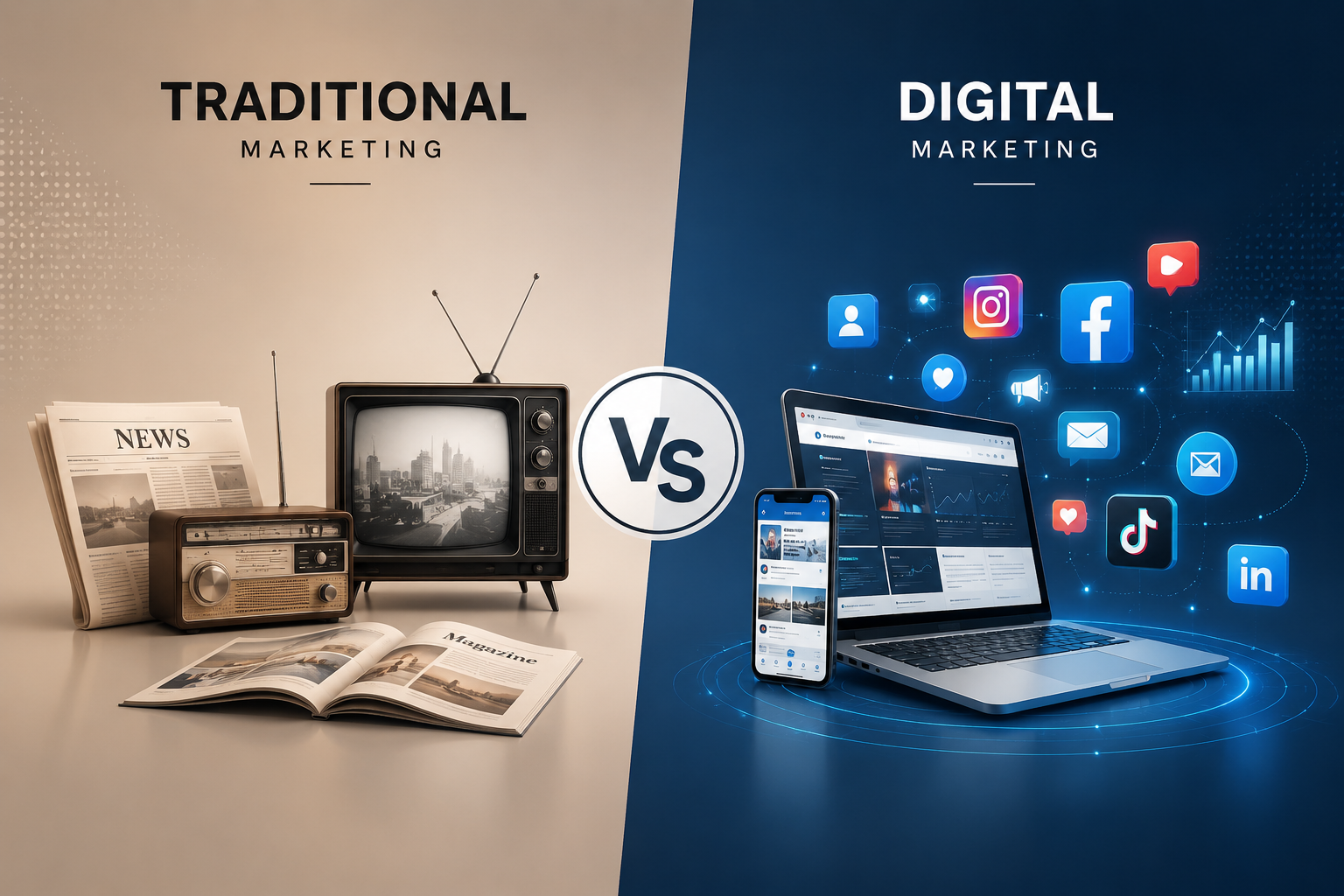
Traditional marketing is performed using printed media like pamphlets, newspapers, magazines, brochures, flyers, and posters. Other methods include audio and video media. Here, audio marketing is conducted using radio ads, and video marketing is performed using television.
Overall, traditional marketing media consist completely of:
- Printed media
- Radio advertising
- Telemedia
1. Printed Media
In printed media, advertisements are created using physical materials like pamphlets, newspapers, magazines, and brochures. These printed materials are distributed throughout a selected area or place.
In printed media marketing, you need to select the target area first. This area is selected based on the target audience. After selecting the location, distribution begins.
- Examples of Print Media: Newspapers, magazines, brochures, flyers, pamphlets, posters, banners, business cards, catalogues, and leaflets.
- Example in Action: A local business placed an advertisement in the newspaper.
2. Radio Advertising
Radio advertising is a type of marketing where businesses and products are promoted using radio broadcasts. This is a traditional type of advertising followed by many businesses.
The reach is highly effective, as it easily connects with a wide range of people. It is also less costly compared to other marketing trends. People can enjoy the advertisements while they are at work or driving.
- Example in Action: A local business placed an advertisement on the FM radio.
3. Telemedia
Traditional VS Digital marketing. Telemedia refers to the television medium. This is a broad medium that can reach customers very easily. Because it covers a wide range, the advertisement reaches people more effectively.
Through telemedia, people experience both video and audio content. Direct communication with customers is possible, and the response is very quick. This makes it an excellent source for lead generation and customer retention.
- Example in Action: Shopping malls display advertisements on television.
Understanding Digital Marketing
Traditional VS Digital marketing. Digital marketing is the marketing we perform using digital media. In simple words, marketing is done by using the internet. Digital marketing launched in the year 1990. Through this method, we reach customers using the internet.
There are many ways to perform digital marketing. The primary tools for digital marketing are mobile phones and computer systems. With the increasing usage of mobile phones, digital marketing is getting stronger day by day.
Main Goals of Digital Marketing
- Understand your customer’s requirements.
- Reach out to them online.
Key Types of Digital Marketing
- Content Marketing
- Social Media Marketing
- SEO (Search Engine Optimization)
- E-mail Marketing
- Pay-Per-Click (PPC)
- Affiliate Marketing
H2: Core Differences Between Traditional Marketing and Digital Marketing
Traditional VS Digital marketing
| Feature | Traditional Marketing | Digital Marketing |
|---|---|---|
| Reach | Reach is limited. It targets a specific local audience only. | Reach is higher. It provides a global reach. |
| Target Audience | It is difficult to find the target audience. | It is easy to find the target audience. |
| Tracking & ROI | Difficult to track results and Return on Investment (ROI). | Easy to track everything with a clear ROI. |
| Cost | Cost is high. | Cost-effective or low cost. |
| Communication | Communication is one-way. | Communication is two-way. |
| Flexibility | Flexibility is lower. | Flexibility is higher. |
| Results | Yields slower results. | Yields faster results. |
Detailed Breakdown of the Differences
Traditional VS Digital marketing
1. Reach
- Traditional Marketing: It provides less reach.
- Digital Marketing: Here, the reach is much higher.
2. Target Audience
- Traditional Marketing: Difficult to find the target audience.
- Digital Marketing: Easy to find the target audience.
3. Tracking Results
- Traditional Marketing: Difficult to track results.
- Digital Marketing: Easy to track results.
4. Return on Investment (ROI)
- Traditional Marketing: It is difficult to measure ROI.
- Digital Marketing: Easy to measure ROI.
5. Price or Cost
- Traditional Marketing: Cost is high in traditional marketing.
- Digital Marketing: Cost is low in digital marketing.
6. Communication Style
- Traditional Marketing: Communication is one-way.
- Digital Marketing: Communication is two-way.
7. Campaign Flexibility
- Traditional Marketing: In traditional marketing, flexibility is lower.
- Digital Marketing: In digital marketing, flexibility is higher.
8. Speed of Results
- Traditional Marketing: It gives slower results.
- Digital Marketing: It gives faster results.
Conclusion
In the present day, Traditional VS Digital marketing, digital marketing plays a crucial role. Everyone is showing interest in digital marketing over traditional marketing. Digital marketing evolves day by day in a rapidly changing and growing world, especially with the integration of AI.